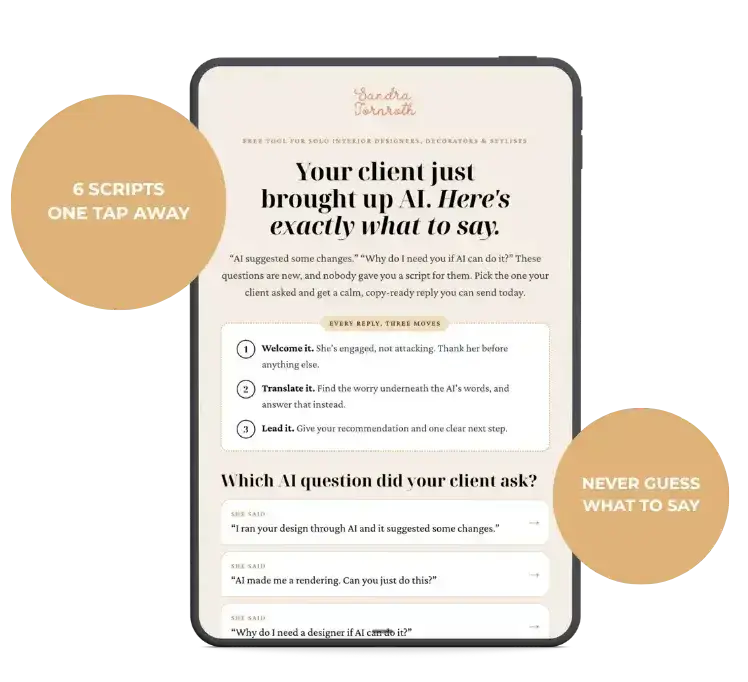
What Are the Red Flags in an Interior Design Inquiry? 6 Signs and What to Say
This one is for solo interior designers, decorators, and stylists, for the moment a new inquiry lands in your inbox. A red flag in an inquiry is anything that tells you, before you have given a single hour away, that this project is likely to cost you more than it pays you. Six of them come up again and again, and each one has words that go with it.
Before the list starts... every designer gets these inquiries. Getting one says nothing about your portfolio or your prices.
I built the Red Flag Tool from the way I learned to spot them, and I'll tell you where that started when we get to number 5.
Why does a wrong-fit inquiry cost you money?
Because the cost lands before you are even hired, and it lands in hours.
I know this one from the inside. When I ran my own studio, I was insecure about my boundaries, so I worked for free and let scope creep in to keep things smooth. Looking back at my old schedules, I estimate about 10 hours of free work per project. At my rate of $250 to $350 an hour, that is roughly $2,500 to $3,500 a project {I have never added up the total}.
That is why a flag is worth catching in the inquiry, not in month three.
What are the six red flags in an interior design inquiry?
There are six, and they come up again and again: free ideas before she has hired you, pushing on the price before anything is agreed, starting before the deposit, a scope that grows before the project exists, fishing instead of deciding, and a feeling you can't put a name on. Here is each one, what it costs you, and the words that go with it.
1. She asks for "just a few ideas" before she has hired you
It usually arrives as something like "could you just pop round and give me a few ideas?" Designers ask me about this one all the time, because it is so hard to say "that's a paid consultation" without feeling rude.
Asking is normal. What makes it a flag is the assumption underneath, that your thinking is free. And your thinking is the part of the work you are paid for.
The words: name the paid consultation plainly, once, with what she gets for it. "I'd love to see the room. Ideas are exactly what my paid consultation is for, so you get them properly thought through, not off the top of my head. Here's how to book it."
2. She leads with the price and keeps pushing on it before anything is agreed
A price question on its own is normal, and it is not a flag.
The flag is pushing on the number before she knows what the work is. When the price is the whole conversation before the scope even exists, every step after it tends to turn into a negotiation.
The words for that first price question, step by step, are in She Asked Your Price in the First Message: 5 Steps to Take Before You Reply.
3. She wants you to start before the contract is signed and the deposit has landed
This one is lovely and tricky at the same time. She says yes, she is so excited, and could you possibly start before the deposit?
My rule here is business mechanics, nothing more: contract signed first, deposit paid second, work begins third. That order does NOT move, however lovely she is and however excited she sounds. Starting before the contract is signed or before the deposit lands creates problems that are very difficult to undo. And a client who is genuinely excited will still be excited next week.
The words can be warm and still hold the order: "I can't wait to get started either. As soon as the contract is signed and the deposit has landed, I'll put your start date in the calendar." {The contract itself comes from a lawyer or a credible legal template service in your own country.} How a proposal sets up that order from the very start is in 5 Steps to an Interior Design Proposal That Feels Safe to Say Yes To.
4. She is already adding "just one more small thing" before the project exists
If the scope is growing while you are still talking, it will grow faster once you are working. Each small thing looks harmless on its own, and together they are exactly how my free hours added up.
The words: put the scope in writing at the start and keep it there. "Love that idea. Let's add it to the scope in writing, so it's planned and priced properly."
5. She is fishing, not deciding
Lots of questions, lots of your time, and nothing moving forward.
This is where the Red Flag Tool began, and it started a long way from interior design. In my corporate finance years, my team rushed the vetting of the other side: one month, where the usual minimum in that business was two. The negotiation then ran about three months before it collapsed, because the other side was never fully committed and was dragging it out while fishing for information about our company. We lost the deal, and the commissions with it.
In a studio it's your hours that go instead of commissions, and it looks exactly the same as it did at that table. Nothing dramatic about it... it just never moves. {Rushing the yes is how I learned that one.}
So now I vet every single time, with the same steps, before I get attached to anything.
The words: answer warmly, then offer one clear next step and let her choose it. "Great questions. The best place to go through all of this properly is a consultation, and here's how to book it."
6. Nothing in the email is wrong, and something still does not sit right
This is the one that matters most. The budget is fine, the timeline works, she seems lovely, and there is still a flicker.
Here's what I keep seeing. The nameable flags sit right there in the email, and all you need is permission to act on them. The felt ones have nothing to show anyone, so they are the easiest ones to talk yourself out of, every time.
So here is your permission. The feeling is real information, and it counts even when you can't put a name on it. You never have to explain it to anyone either {not to a friend, and not to the client}.
What do you actually say when it is a no?
One reason, not five, and it has to be one she genuinely cannot fix.
A no that explains itself invites a negotiation. Every extra reason is something she can answer, and suddenly you are discussing your no instead of standing by it. And softening a no into a smaller package or a lower price is not a gentler no. It is a yes on worse terms.
Here's what one sounds like:
"Thank you so much for thinking of me for your home. What you're looking for is outside the work I take on, so I'm not the right designer for this project. I really hope it turns out beautifully."
Warm, short and final. Then you let it be {no follow-up essay needed}.
Questions people ask about red flags in an inquiry
Does one red flag mean I should always say no?
No. One flag can still be a yes, with a couple of things to watch, like getting the scope in writing early. A nervous client who needs more hand-holding is part of the job, and a client whose problem is not yours to fix is something else entirely.
What if I need the money this month and the inquiry has a flag on it?
That is a real pressure, and it is a fair question. Before you say yes, look at what the flag is likely to cost you in hours, because a project that quietly eats unpaid time pays far less than it looks. If you do take it, name the flag to yourself and put the scope in writing from day one.
Is it rude to say no to someone who found me herself?
Not at all. A clear, kind no is a respectful answer, and it is far easier to receive than silence {we all know how that one feels}. I wrote about the other side of that silence in Why Do Interior Design Clients Ghost After the Proposal? 5 Steps to Take When It Happens.
What if I have no flag I can point to, only a feeling?
Then the feeling is the flag, and it does not need proof before it counts. Write down what you noticed, check it against the five nameable signs above, and make the decision on purpose instead of talking yourself past it.
If you'd like somewhere to take the next inquiry that gives you that flicker, that is what I built the Red Flag Tool for. It's a two-minute quiz that turns the flicker you already felt into one clear answer, and if the answer is no, the words to say it are already written for you.
I'm Sandra Törnroth, a business and sales strategist for solo interior designers, decorators, and stylists. Twenty years in business: ten in corporate finance, at the tables where high-stakes deals were negotiated, then ten in business strategy and sales for creative businesses.