What Does a Good Interior Design Client Onboarding Process Look Like? 6 Steps After She Says Yes

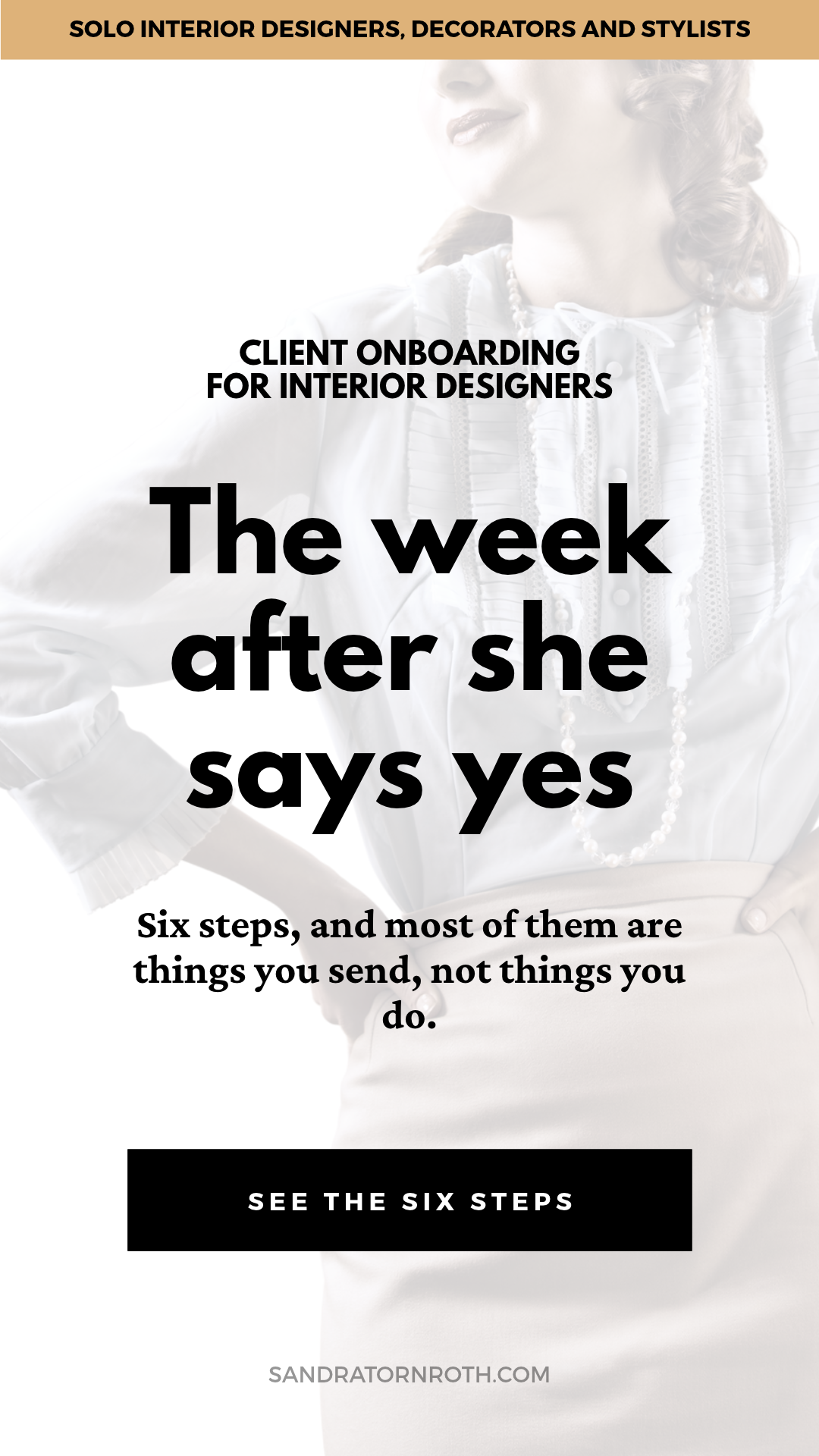
This one is for solo interior designers, decorators, and stylists, for the week after a client says yes. A good interior design client onboarding process is short, and almost all of it is written down: the project agreement and the deposit invoice go out the same day, she gets the order of what happens next, the scope is on paper, and the kickoff sits in the calendar before any work starts. Six steps, and most of them are things you send rather than things you do.
I learned this one the slow way, and I have told the short version before. Back when I ran my own studio, three projects worth $5,000 each came in while I was busy with branded photos and looking the part, and I dropped the ball on onboarding them in a way that signed them. It was a flaw in focus and process, and it had nothing to do with the design.
This is the long version. Onboarding is the last stage of the whole path from inquiry to signed client, and it is the stage I see left to chance most often. So here it is, in order.
Why does the week after she says yes matter so much?
Because a yes out loud and a signed project are not the same thing yet, and what you send next is what carries her from one to the other.
She has just agreed to let a person she barely knows make decisions in her home, for a sum of money that is probably one of the bigger ones in her year. Clients decide on trust long before they decide on style. The days right after the yes are where that trust is either built or quietly left to chance, and a plain, written process does more for it than a beautiful deck ever will.
You worked hard for that inquiry. This is the part that turns it into a booked project.
What does a good interior design client onboarding process look like?
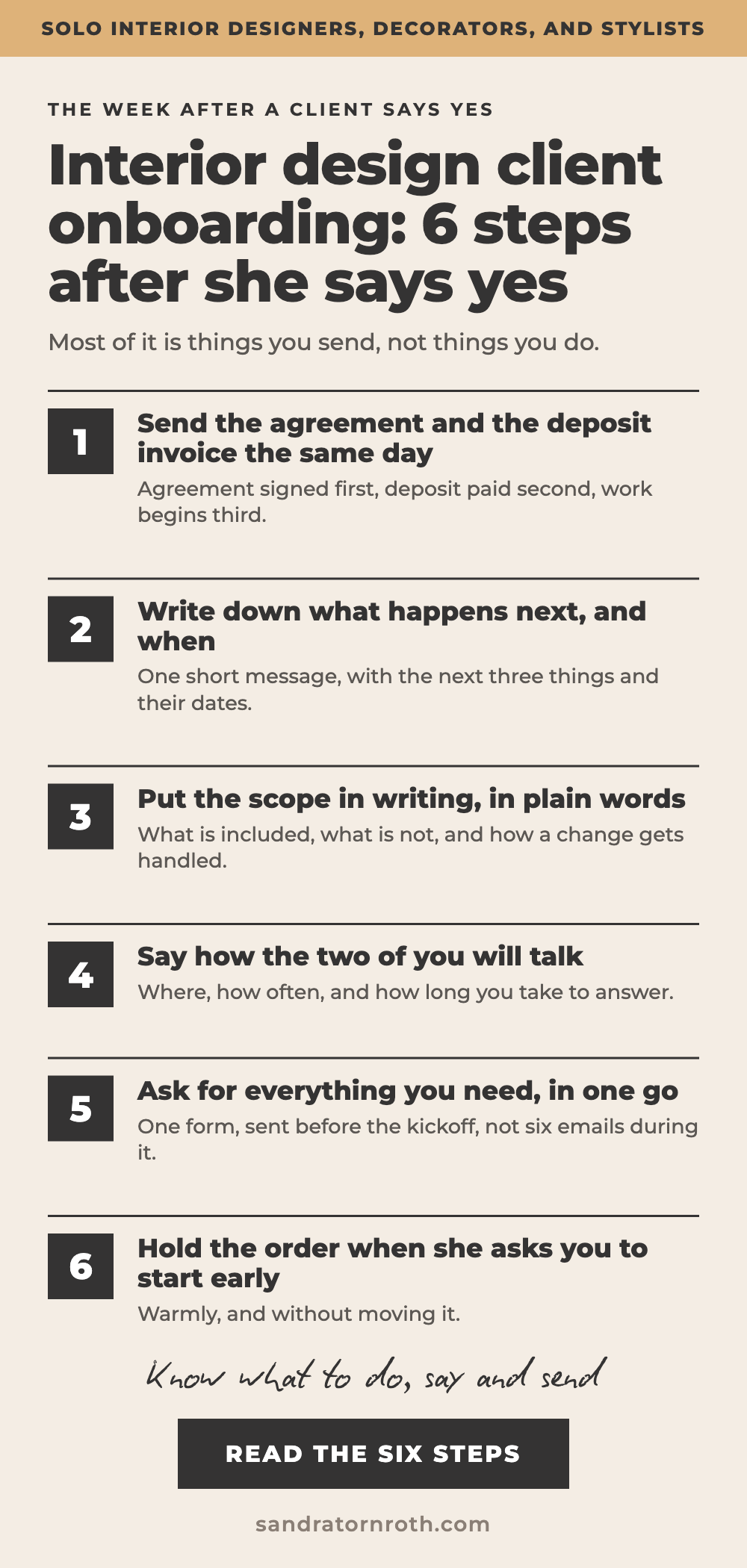
Six steps: the agreement and deposit, the what-happens-next message, the scope in writing, how the two of you will talk, what you need from her, and holding the order if she asks you to start early. Here is each one, why it matters, and what it sounds like.
1. Send the project agreement and the deposit invoice the same day
The order does not move: agreement signed first, deposit paid second, work begins third.
Same day, because the yes is a decision she just made and it is easiest to act on while it is fresh. It is also the least awkward moment you will ever get to send an invoice... she is expecting it. Leave it a week and sending it starts to feel like a conversation instead of a step.
The agreement itself comes from a lawyer or a credible legal template service in your own country. That part is not mine to write for you, and it is not something to borrow off the internet.
2. Write down what happens next, and when
One short message, with the next three things and their dates.
Not the whole project plan. Just what you will send her, what she needs to do, and when the kickoff is. A client who knows what is coming does not have to chase you for it, and that is one less email in both your weeks.
It can be this plain: "Here is the agreement and the deposit invoice. Once both are back, I will send you a short form with everything I need from you, and we will have our kickoff call on the 12th. I am really looking forward to this one."
3. Put the scope in writing, in plain words
What is included, what is not, and how a change gets handled.
Write it the way you would say it out loud, not in clauses. Rooms, deliverables, how many revision rounds, what happens if she adds something later. Each extra little thing looks harmless on its own, and together they are exactly how unpaid hours pile up in a project that looked fine on paper.
The words for an addition, when one comes: "Love that idea. Let's add it to the scope in writing, so it is planned and priced properly." I wrote about spotting that pattern before you are even hired in What Are the Red Flags in an Interior Design Inquiry?
4. Say how the two of you will talk
Tell her where, how often, and how long you take to answer.
This is the step almost nobody writes down, and it is the one that protects your evenings. Email for decisions, an update every Friday, two working days for a reply. A client who knows she will hear from you on Friday does not message on Tuesday to check you are still there. And when something does need deciding, it gets decided in one place instead of across four.
5. Ask for everything you need, in one go
One form, sent before the kickoff, not six emails during it.
Measurements, photos, the deadline that actually matters, who else is involved in decisions, and the budget as it stands now. Asking for all of it at once reads as organised. Asking in pieces, over two weeks, reads as unsure, even when you are not.
A simple Google Form does this perfectly well. It does not need to be designed.
6. Hold the order when she asks you to start early
Warmly, and without moving it.
This is the moment designers write to me about most, and it always sounds about the same: "The client said yes, then asked if I could start before the deposit, because she's so excited. I said yes. Of course I said yes." There is nothing unusual about saying yes to that.
Starting before the agreement is signed or before the deposit lands creates problems that are very hard to undo later, and a client who is genuinely excited this week will still be excited next week. {That is worth remembering on the days when waiting feels rude.}
The words can be warm and still hold the line: "I cannot wait to get started either. The moment the agreement is signed and the deposit has landed, your start date goes in my calendar."
What does your week look like once she says yes?
Short, if the pieces are already written.
Day one: the agreement and the deposit invoice, plus the message with the next three things. Day two to five: her form comes back, the scope is confirmed in writing, the kickoff is in both calendars. Then the work begins, with the deposit already in your account.
The whole thing runs on having the words written before you need them. Then the week after a yes is a few things you send, in order, on an ordinary Tuesday.
Questions people ask about interior design client onboarding
How long should onboarding take?
Days, not weeks. If the documents are already written, the whole thing is one message, one signature, one payment and one form. The longer the gap between her yes and your first email, the more of the momentum you are asking her to hold on her own.
What if she says yes and then goes quiet?
It happens, at every stage, and it is far more often about her week than about you. Follow up on the thing, not on the feeling: one short message pointing at the document still waiting, with the date it affects. The longer version is in Why Do Interior Design Clients Ghost After the Proposal?
Do I need a welcome pack or a branded PDF?
No. A clear email does the same job. A welcome document is lovely once the plain version is running, and it is the thing to build last, not first.
What if I have already started work without a deposit?
Then you send the agreement and the invoice now, today, as a normal next step rather than an apology. "Before we go any further, here is the agreement and the deposit invoice, so everything is properly set up." It is not too late, and it is not awkward unless you make it so.
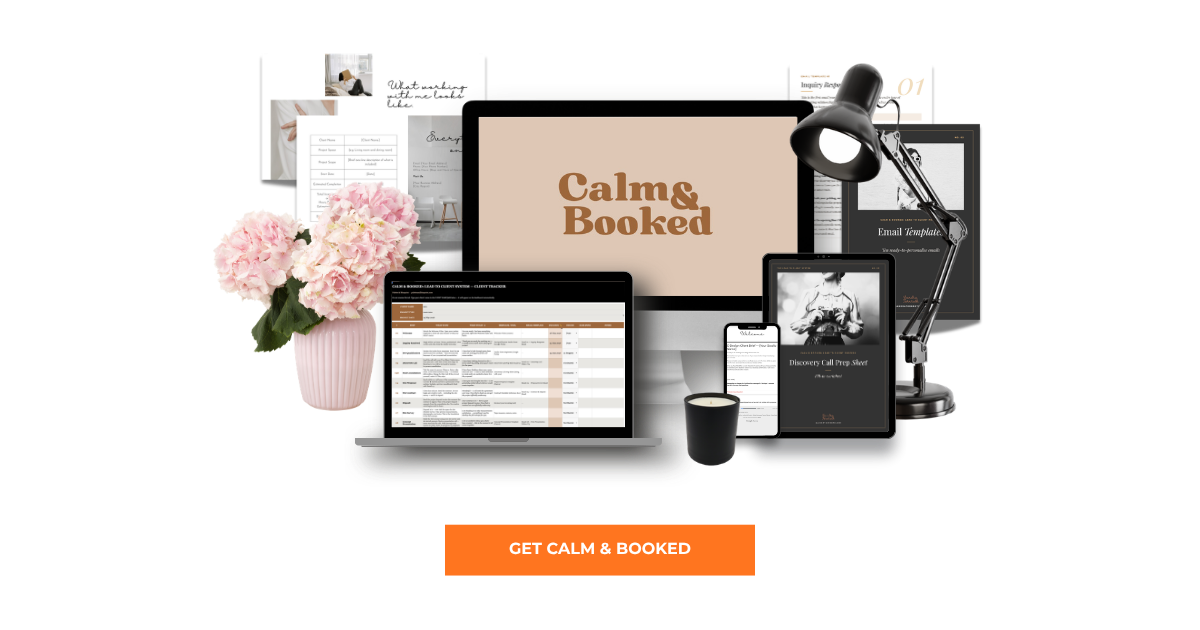
If you would like every one of these pieces already written, that is what I built Calm & Booked: Lead to Client System for. It holds the ten steps from the first inquiry to kickoff, grouped into four toolkits, with the scripts, checklists and templates for each one... so the messages in this post are already written and waiting the next time a client says yes.
I'm Sandra Törnroth, and I teach solo interior designers, decorators, and stylists sales and client communication: what to do, say and send, from the first inquiry to the signed client. Twenty years in business, and my own design studio along the way.
This post is for informational and educational purposes only. It isn't legal, financial or professional business advice, and results aren't guaranteed. Every business is different, so take what fits yours.